From Reading to Remembering: Generating Flashcards & Quizzes
Reading and re-reading the same material is one of the least effective ways to make it stick. Cognitive science has known this for decades: passive re-exposure produces a shallow sense of familiarity without building the retrieval pathways that make knowledge usable under pressure. What actually works is active recall — the practice of generating an answer from memory rather than recognizing it on the page. LearnBook's flashcard and quiz system is built around this principle. For a tour of all the features in this category, see the using LearnBook guide collection. Every item it generates is grounded in your specific source material, cited back to the passage it came from, and scheduled for review at precisely the intervals where retrieval practice does the most good.
How LearnBook Generates Flashcards and Quizzes
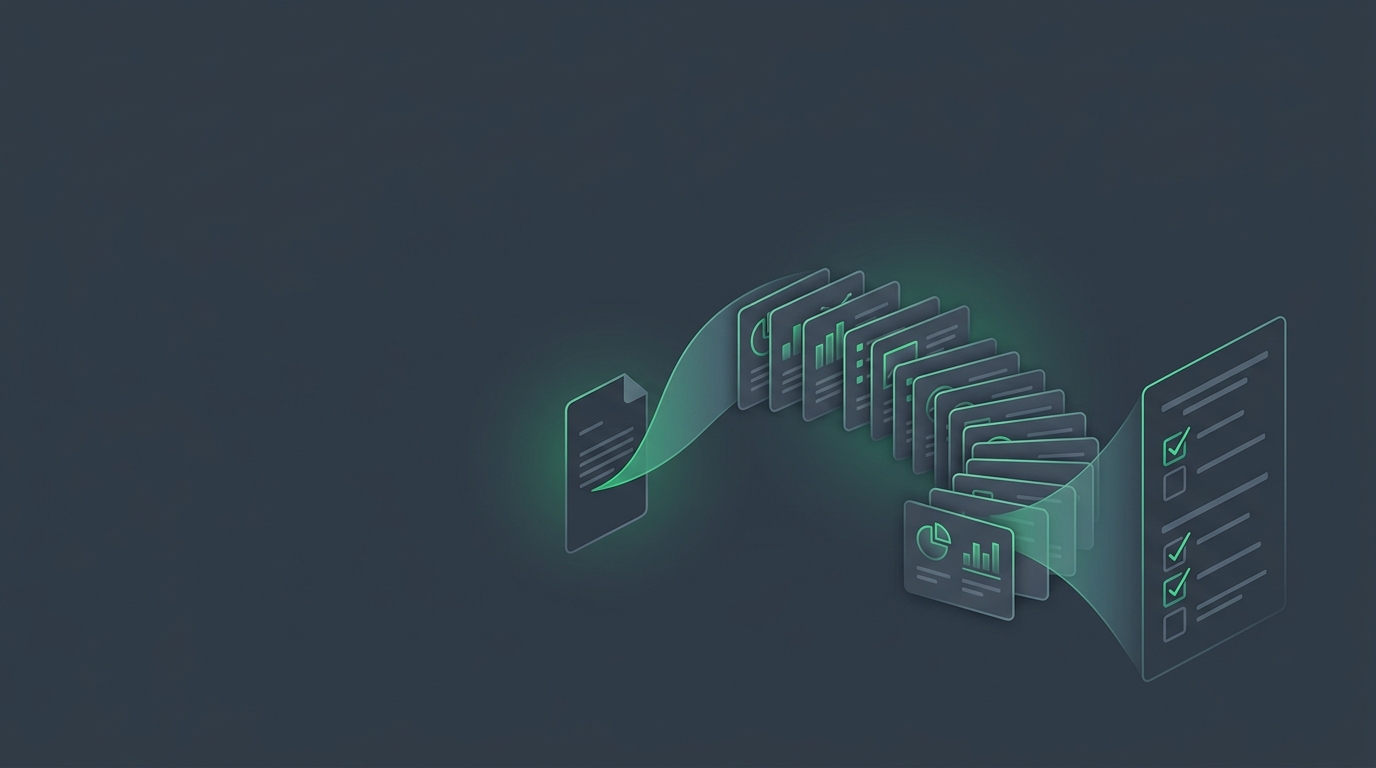
When you compile a source in LearnBook — whether that's a PDF, a YouTube lecture, a web article, or your own notes — the compile step doesn't just create a readable document. It also analyzes the content and produces an initial set of flashcards and quiz questions drawn directly from the material. This happens automatically; you don't have to identify what's worth memorizing or write prompts yourself.
The generated items are grounded: each one links back to the specific passage or section in your compiled source that it was drawn from. This matters for two reasons. First, you can always check the original context if a card feels ambiguous or if you want to understand the fuller argument around a fact. Second, it means the items aren't generic — a flashcard from a biochemistry paper looks different from one generated from a history lecture, because the content being tested comes directly from what you're studying, not from a shared question bank.
Types of Recall Items
Flashcards
Flashcards in LearnBook follow a question-and-answer format. The front of the card presents a prompt — a concept, a term, a relationship, a key claim — and the back provides the answer grounded in your source. After reviewing a card, you rate how well you recalled it, and that rating feeds the FSRS scheduling algorithm to determine when you'll see the card again. Cards you find easy are pushed further out; cards you struggle with come back sooner. Over time, the deck adapts to your actual memory rather than treating every item as equally hard.
Quizzes
Quiz questions take a multiple-choice or short-answer form and test comprehension at a slightly higher level — understanding a concept well enough to distinguish it from plausible alternatives, or applying it to a new formulation. Quizzes work well for testing whether you understand why something is true, not just whether you can recall a definition. Like flashcards, quiz questions are tied to specific passages in your source so that reviewing an incorrect answer means reading the relevant section, not just accepting the correct option.
Reviewing and Editing Generated Items
Automatically generated items are a starting point, not a final product. Before entering the review queue, you can look through the generated set and make adjustments:
- Edit wording — if a question is phrased in a way that doesn't match how you think about the concept, rewrite it. The citation anchor stays intact.
- Remove low-value items — not every generated card will be worth your review time. Delete items that test trivial details or that duplicate other cards in the set.
- Add your own cards — you can create additional flashcards and quiz questions from scratch, or based on notes or highlights you've made while reading. These enter the same FSRS review queue as the generated items.
The goal is a deck that tests the things that actually matter for your learning objectives, at a density that makes review sessions sustainable rather than overwhelming.
How Items Enter the FSRS Review Queue
Once you've reviewed and confirmed the generated items, they enter LearnBook's spaced-repetition queue, scheduled by the FSRS algorithm (Free Spaced Repetition Scheduler). FSRS is a modern scheduling model that predicts the probability your memory of each item will drop below a retrieval threshold, and schedules your next review just before that happens. This means you're reviewing items at the moments where practice is most likely to strengthen long-term retention — not too soon (when the memory is still fresh and review adds little), and not too late (when you've already forgotten and have to relearn from scratch).
You can read more about how the algorithm works in our article on how FSRS works, but the practical effect is straightforward: your review workload stays manageable because you're not reviewing everything every day, and your retention improves because the items that keep coming back are exactly the ones your memory needs to consolidate.
Cross-Book Review
When you've compiled multiple sources in LearnBook, your flashcards and quiz questions from all of them are available in a unified cross-book review session. This is useful for courses or subjects that span multiple sources — a textbook chapter, a set of lecture videos, and a collection of articles all studying the same topic. Cross-book review surfaces interleaving: you practice recalling from different sources in the same session, which research suggests improves the durability of learning compared to blocked practice on a single source.
The Active Recall Loop in Practice
The most effective use of LearnBook's flashcard and quiz system follows a rhythm that mirrors how memory consolidation actually works:
- Compile your source. The compile step generates the initial recall items alongside the structured document.
- Read and ask questions. Use the AI tutor to clarify concepts while reading. This deepens your initial encoding before you start active recall practice.
- Do a first-pass review soon after reading. Reviewing the generated items within a day of reading takes advantage of the encoding while it's fresh. Items you can't recall now get scheduled for a short interval; items you recall well get pushed further out.
- Return for scheduled reviews. LearnBook's review queue tells you which items are due each day. These short sessions — often just a few minutes — do more for long-term retention than another full re-read of the source.
- Track your mastery trends. As your recall performance on a compiled source improves over time, you can see the mastery trend in your course dashboard. Items that were once difficult shift from frequent review to occasional maintenance.
For a deeper look at why this process works, see our guide to active recall.
What Good Flashcards Actually Test
A common mistake when building flashcard decks manually is writing cards that test surface recognition — the kind of memory where seeing the question makes the answer feel obvious, but you couldn't have generated the answer without the prompt. LearnBook's generated cards aim to avoid this by focusing on:
- Concepts and definitions that require you to produce a precise explanation, not just nod at the right one.
- Relationships and mechanisms — why something works, how two ideas connect, what the cause-and-effect chain looks like.
- Application prompts that ask you to use a concept rather than just recall it.
You'll notice that well-generated cards feel slightly harder than expected. That's by design. The mild difficulty of retrieval — called desirable difficulty in the learning science literature — is precisely what makes recall practice more effective than re-reading.
From Reading to Remembering
Flashcards and quizzes aren't a study supplement you add after the "real" learning is done. In LearnBook's model, they are the learning. Compiling a source, generating recall items, and working through scheduled reviews is the full loop — the process by which something you read once becomes something you know months later. The generation step is automatic; the review habit is the practice that builds mastery.
Compile your first source and see what active recall looks like when every card is grounded in your own material — not a generic question bank — and scheduled to arrive at the moment your memory actually needs the practice.
Share
Related Posts

Upload a PDF, paste a web article, drop in a YouTube link or your notes — LearnBook compiles any source into a structured, studyable book.
Ask questions grounded in your sources, get Socratic explanations, and let FSRS schedule your reviews. A tour of LearnBook's learning loop.